

What Is The Best Assistive Communication App?
Search for Solutions Here:
Communication Apps: The Best AAC Apps for Kids
Communication Apps: The Best AAC Apps for Kids
Communication Apps, also known as AAC Apps, can be incredibly powerful tools to help a child who is not able to speak learn to communicate with those around him. These apps are used for children who have difficulty using speech to convey their thoughts and ideas. For those children, an alternative means of communication could be beneficial.
Here's a review of some of my favorite communication apps. If you'd like more information about How to Teach a Child to Use an AAC Device, Click Here!
**Please note, the links to the communication apps in this post are affiliate links that will give me a small kickback from I-Tunes if you go through these links before purchasing. This will allow me to keep providing great content at no extra cost to you. Thank you in advance if you choose to use my links!
Communication Apps:
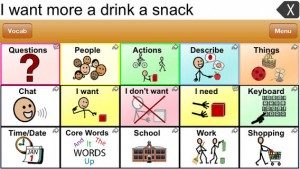
TouchChat
Touch Chat AAC App
Available On: Itunes App Store
Price: $149.99 (for a few basic boards) or $299.99 (for TouchChat with Word Power-recommended)
Review:
This app was created by Saltillo which is a company that makes dedicated AAC devices as well as communication apps. That means, this same software comes installed on their durable devices that are designed to be used specifically as an AAC device and nothing else. Why is that a good thing? Well, you know that they've spent tons of time and money on research and development of their software and if you try the app and find you like it, you can easily transition to a dedicated device that will last you longer and is often covered by insurance companies.
I recommend purchasing the "Touch Chat with Word Power" option, which is more expensive but gives you access to the word power boards which will allow for much more language use and development in your child. When you open the app, you have the option to choose from many different pre-programmed boards that are specifically designed for different populations. You can start with very simple boards that were designed for young children with developmental delays or move up to a more sophisticated device. There are even specific boards for adolescents that has bigger buttons for those who aren't ready for the more sophisticated boards, but who need more sophisticated language than a preschooler would need.
Saltillo used research conducted in adolescent homes about the types of vocabulary that these children want to use. The "Word Power" boards are much more sophisticated and allow for more language development and growth. These boards range from 20 buttons per page up through 80 buttons per page, allowing the child to have access to as many buttons as his motor skills will allow.
I personally use the 42 Position option the most often and I love that there is a basic version and a more sophisticated version of the same 42-button layout. The more sophisticated option changes certain words on the screen when one button is pushed, allowing the device to predict what you may be trying to say. This cuts down on navigation time significantly. However, the basic version of this doesn't allow buttons to change as much and includes more pictures/symbols on buttons instead of plain text. This allows for you to customize the device to the individual child with the push of a button.
Once you choose a board, the boards themselves are also easy to customize and you can easily hide as many buttons as you need to. This is great for a kiddo who is just starting out and needs help guiding her attention to the target button. When she's ready, the buttons can easily be added back on. There are also features that can be used to allow the child to change pages quickly using gestures. I found these troublesome with some of my younger children because they would accidentally do the gesture while trying to push a button and it would change pages. Fortunately, these can be turned off for your little ones.
The website for Touch Chat contains tons of support and resources including Webinars and Trainings. Plus, since the app is provided by a company that sells full AAC devices, you always have access to a local rep who can tell you all about the dedicated AAC devices if you decide that your child would benefit from having his own AAC device.
What I love About It:
- Created by a company that makes dedicated AAC devices as well as communication apps so it's easy to transition from app to a more durable device
- Pre-programmed boards are specifically designed for certain ages or populations, including a set for adolescents who are often overlooked in the AAC world
- Within each button size option (how many buttons per screen), there are options for more basic boards or more sophisticated ones
- Easily hide and edit buttons
- Tons of support online plus local reps that will show you how the dedicated devices work
DynaVox Compass
Available On: Itunes App Store
Price: Free for one month, 29.95 per month after that
Review:
This is a new app from a company called Dynavox which is another company that creates dedicated AAC devices. That means you get all of their knowledge and expertise behind each product as well as an easy transition from communication apps to a dedicated device if you decide to go that route. In fact, Dynavox is one of the oldest AAC companies around so they have tons of research and development under their belts and their new app proves that they're not just settling for what they've done in the past, they're always pushing the limits and advancing their technology and programs.
One of the first great features about this app is the fact that you can download it for free for 30 days! None of the other communication apps reviewed here have a free trial version. This can be so helpful when trying to find out if something works for your child. Then, once you finish your trial you have the option to subscribe to the monthly service which allows you to pay a month at a time. This is especially helpful if you want to just try the app for a while to see how your child does or if you are eventually planning on getting a full evaluation to have insurance pay for a dedicated device, as this company will be able to sell you that as well. The cost to try AAC is much less with this app than any other, at least in the short term.
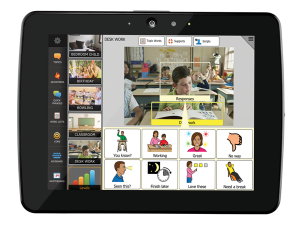
The next awesome thing about this app is that there is a setup wizard which will ask you a series of questions and help you choose the best board for your child so you don't have to try every pre-programmed board they have until you find one. There are several different layouts that you can choose from and that it will recommend for you. However, if you choose one layout and decide you want to try a different one, it's easy to switch. They have a few layouts that are very similar to other layouts we've discussed but their new one is quite unique. It's called the NavBar layout and it contains a side bar with tons of helpful tools for your child. You can choose more traditional layouts that resemble other AAC devices, but I want to talk about the NavBar layout because it is so unique!
The words your child needs are grouped into the following categories along the sidebar: topics (you choose activity-specific pages that are relevant to your child, like blowing bubbles or going to the bathroom), quickfires (common words or phrases that are frequently used), quick phrases (longer phrases that your child may want to use often, like "I need to take a break"), word lists (lists of categories with words within each), and core (words that are used to build sentences, like common verbs and grammar words). This allows for a huge variety of words that your child can have access to.
Also, along the side bar, there is a keyboard which will predict what you're typing as well as a white board, which could be used for a child to draw or write what they're trying to say if they're having trouble finding the button. You can also save pictures on the white board that they can share with others later. Another awesome feature which I haven't seen in any other device is the behavior supports that come with each topic page. For example, if you're in the "bubbles" page, not only are there tons of bubble-specific vocabulary and phrases, but you can also go into the behavior supports page and find options for a visual timer (to know when bubbles are done), visuals that depict rules about bubbles (like how they should be used outside or how you have to stay at the table), a visual sequence that depicts the steps of bubble time, if-then boards that will tell a child the consequences of specific good and bad behaviors during bubble time, and a story that tells about bubbles as your child pushes successive buttons.
Each topic also contains scripts that are full sentences your child can use to talk about that activity. However, if you ever feel like there are too many options for your child, you can turn any of these features off. Another feature I love about this app, is that you can include visual scenes to be used along side the other buttons. Visual scenes are pictures of a scene (like kids playing a game or the layout of a kitchen). When you push a part of the screen, it will either speak a message or bring up vocabulary specific to that area of the scene (such as bringing up cold foods on the fridge or bringing up dishes in the cabinet).
This can be very helpful for children who do not yet understand all of the symbols that represent different concepts. With this app, you don't have to choose between visual scenes and grids or between phrases and single words, you get it all! Finally, I love how easy it is to level up or down the app. If your child is struggling, you can easily go back to an easier board. If your child is doing well, you can easily step it up to a new one. You can also just make parts of the app harder or easier if there is a specific section your child is having trouble with. For example, you could have tons of core words on there but have easier boards for the topics that your child is less familiar with.
The website for this app is great because not only does it include resources and support, but you can also create an online account that can help you transition between the app and a dedicated device. You get to keep the same account and can even upload the boards you were using on your app to your online account so you can edit them on the computer or transfer them to a different device.
What I Love About It:
- Created by a well-established AAC company
- Free 30-day trial, plus monthly subscription after that
- Setup Wizard helps you find exactly which board to start with for your child but you can easily switch to a different layout at any time
- NavBar Layout contains a sidebar with great tools and unique organization
- Tons of words available
- Keyboard predicts what you're typing
- Whiteboard allows the user to draw or write and allows for sharing pictures of past events (such as from school to home or home to school)
- Behavior supports that are specific to certain activities, such as rules and visual schedules
- Scripted sentences for the child to use to talk about an activity in more depth
- All additional features can be hidden and the pages can be customized
- Can use visual scenes along with the grid-style word layout
- Don't have to choose between visual scenes and grid-layout or between single words and phrases, you get it all!
- Easy to level up or down the app if it is too easy or too hard
- Great web support along with an online account that transfers to any device you end up using
Avaz
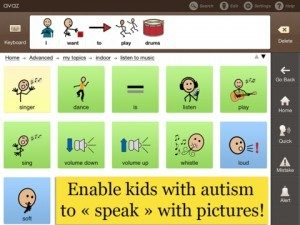
Available On: Itunes App Store, Google Play Android Store
Price: $99.99
Review:
This communication app is designed for children with autism and definitely goes beyond your every day basic communication apps. When you first open it, you will see a helpful sidebar at the right of the screen which offers quick choices such as going back, going home, using quick phrases, an error button that will immediately say "I made a mistake", and an alert button that plays a doorbell type noise that could be used to gain attention or alert a listener to a problem.
That last one is a feature I haven't seen on other communication apps. This side bar, along with the other buttons, adds functionality that some communication apps are missing. From the home page, you can access core words or more advanced screens that contain topic-specific vocabulary words. This page can be customized to only show the pages that are most helpful for your specific child. This app is extremely customizable and you can turn off any feature that you find you don't need.
For example, there is a zoom feature that can be activated to zoom in on the button you just selected. This may be helpful for some children (such as those with visual impairment or distractibility) but it drove me nuts so I was happy to find I could turn it off. You can also hide/show any of the buttons if you need a less-distracting screen. You can also change the button size so that there is just one button per page all the way up through 40 pictures per screen. This is helpful for children with vision or motor problems as well as those who are just starting out with AAC.
Other features highlighted on the website include the ability to track the child's use of the device during therapy sessions to mark progress, reinforcement via animation, use of consistent motor plans, and prediction with pictures. The Avaz website has tons of support resources with videos and guides. It also includes a list of their local resource centers which will provide assistance if you live near them.
The website also includes info about the research conducted to design the app. Although I do not have any experience using this particular app with specific children, I find the app easy to use and full of great tools and resources for children who require an assistive communication device. This is a great one to check out!
What I love about it:
- Available on Android
- Reasonably priced as far as communication apps go
- Side bar allows for easy access to home, quick phrases, an error button, and an alert button which simply plays a tone to gain attention (very cool tool)
- Contains core vocabulary as well as topic-specific words
- Very customizable for each child
- Button sizes of 1 button per screen through 40 buttons per screen
- Backed by research
More Resources for Speech-Language Pathologists:
Looking for more therapy ideas and resources to help you provide the BEST services to your clients? Join us in The SLP Solution, our membership program for speech-language professionals! Inside the membership, you'll find:
- Step-By-Step Guides for teaching a variety of speech/language/communication skills
- Pre-Made Worksheets and Therapy Activities for hundreds of different topics
- Training Videosfor dealing with difficult disorders or problems
- Answers to Your Questionsin our exclusive SLP community
- Tools and Resourcesto help you with your paperwork and admin tasks
- Continuing Educationthrough our monthly webinars and webinar recordings
To join us in the full SLP Solution, or to snag a free membership, click on the button below!
Share This Story, Choose Your Platform!
Related Posts
This site uses Akismet to reduce spam. Learn how your comment data is processed.
What Is The Best Assistive Communication App?
Source: https://www.speechandlanguagekids.com/aac-apps-review/
Posted by: moandin1942.blogspot.com
24 Comments
Thank you for all of your hard work. What a great resource!!
Thank you so much for your kind words! Glad my site is helpful!!
Great Info. Thanks for sharing!!
Thank you so much for doing this! I am looking for language program and was thinking how difficult it was going to be to compare programs. A lot of people are using proloquotogo, but my son's SLP last year switched to LAMP and it does seem to be a better fit.
I'm so glad I could help!
This is very good information that I wish I understood a bit better. We are debating how to replace a Dynavox V that was stolen but hoping for something cheaper. If the same device could also get him to YouTube he would be even happier as his current IPad 1 is on its last legs. There are a few things that some of your reviews don't detail very well. I would like more detail on what hardware and software flavors or versions are required. Some of the descriptions also sound like their program has a more or less fixed vocabulary and icon set that can have some parts just turned off while other apps can be, or need to be, fully programmed as to number of icons per page, how many levels available, and what each icon can do (talk, add to sentence, go to another page etc. I have a full setup I made with the Dynavox editor and like the flexibility but may have to learn something new. I am also worried that IPads might be a bit more fragile than tablets and I wish they were a bit larger.
Hi there!
I completely understand how confusing and overwhelming this process can be! While I can give you a basic overview of these apps, I cannot answer all of the questions you have. I highly suggest you meet with an AAC evaluation team and let them know that you're looking for something cheaper than the Dynavox that you're needing to replace. That team will be able to match you up with a device that meets your child's needs as well as your family's needs (such as determining which level of programming you're up for and what type of device would be best). There are also some apps that are available on other platforms other than iPad if you're interested in a different device so they'd be able to help you with that as well.
This year, my SLP transitioned one of my students from TouchChat (which she is quite proficient on and we both love the hierarchical structure, although it is limited in academic vocabulary so I have to add a lot of pictures and pages) to LAMP. In order to access what she already knows, we have to have at least 2 levels activated. Now she is completely confused as to whether hitting "help" or "yes" or "want" on the top page actually counts as a button push. So now for a "want pull" requests, she's hitting combos like "want, pull, I want, want, pull" just to make sure she's got it all in and the OCD thing is kicking in to where she is hitting longer and longer strings lest she miss one and not get her request approved. She has no expressive language except this AAC and limited receptive language (known 1 step directions in our daily routine often coupled with gestures). I feel that LAMP seems to require more understanding of the structure of language itself since the pictures are not intuitive in many cases. Because I'm not an SLP, my knowledge about the basic growth of language is limited to 1 class in my prep program. Any ideas or suggestions for evaluating a student's basic level of structural language mastery?
Hey there! LAMP programs definitely have more options available to users in terms of using language long-term, but as with any big change like that, there will be a period of confusion. This would be the same if a child were learning to speak one language and then moved to a foreign country and had to start over. The child would be confused as to how to use the different structures for a while. However, constant immersion in that language will eventually help the child figure it out. For an AAC user, that means that the more the child is shown how to use the device correctly (modeling the correct structures on her AAC device as you talk to her), the better she will get at it. Have faith that your SLP knows what system will work best for her long term and seek help from her from during the confusion/transition time. As for evaluating her basic level of language mastery, it will be hard to tell exactly what she knows during this transition time. I would instead resort to describing specific observations you've made about her use of language right now (if you need to collect data) and just explain that it has been affected by the change of AAC systems but that you expect to see continued progress with continued modeling and teaching.
Great! Thanks for sharing!!
Thank you for your thoughtful reviews. We've run into a problem that may lead me to "start over" with an entirely new app after 5 years that my son had first a dedicated Saltillo SGD/AAC device and now their basic TouchCHAT. I'm relieved to see your comments on the expansions for Saltillo but thinking maybe DynaVox Compass is the way to go next. You decided against LAMP-training, but I'm still considering getting it. Because their system is so standardized, it might require less ongoing vocabulary maintenance. With my son now an adult, and myself an SLP, I cannot continue to program custom buttons and pages left and right.
I definitely support going to the LAMP training! I never really decided against it, I just didn't have the time to go. I would definitely be interested in going if I had someone who would benefit from the program. I just couldn't talk about the apps with any experience since I didn't attend it. I hope it works for you guys! They are a great company.
my kid has autism and he is non-verbal and has a CAS (childhood apraxia of speech) . He's now 8 and we are undergoing therapy since he was 2 years old. We tried also PROMPT but we're still having difficulty. Good thing his comprehension is okay so when we started using AAC- Touch chat specifically, my child can now express his needs and it lessened frustration for the both of us. It is expensive though but worth it.
As a mother, we really have to know and exert every effort to help our child. With prayers, patience and love we can achieve anything!
I'm so glad that you've found help with the AAC apps! I do love Touch Chat!
My 15yo son is non-conversational. We have Proloquo2go, which we really haven't used. Our SLP is recommending TouchChat with WordPower since it is what is used on the NovaChat device that the school uses. Does anyone have experience with both that can tell me if buying TC is worth it? What's the big difference? It's currently half price, so now would be the time to get it. Thanks.
Thank you for this information. If I could pick your brain….I have a few students who are not able to handle the robust nature of Words for Life but still want to give them access to language opportunities in a simpler format. I don't want it to be too simple that they are only making requests. Do you have an suggestions as to communication apps or devices that may be better suite to these non-verbal children who also happen to have motor planning issues globally? Thanks.
Holly
i am new member .My son is now 11 but since 8 yrs having emerging skill in speech, reading and writing before that he din't had.He has autism, apraxia and little intellectual disability but good at many other things like swimming, learning drums. but I want to know which is good AAC app for non verbal, apraxia kids who won't do much navigation. We started with Avaaz , he started requesting things with that and now he does verbally but only single words. And with prompting by us would now say very small phrases but not yet independently and he stopped using his iPad. I want him to say in small phrases initiated by himself without being prompted , or type in sentence quickly and encourage him to use more often and that will help in talking. Becoz once he saw he can put i want …,i like he started verbalizing the same thing but for more stuff there was too much of navigation and his apraxia wuld make him confuse so now we are in road block how to proceed , would like to have to have sentence or speech prediction with grammar/syntax using core/connecting words should be there so that he can do himself without some one prompting and would know how sentence is constructed and not just words what he wants to say.Otherwise we have to customize for each sentence and too much of navigation. Avaz lacks this feature may be its newer version has but i want to try something better.Which will be good proloquo 2 go or proloquo 4 text , compass by Dynavox or touch chat HD. These are the options they are giving now . I felt dynavox better among these while doing research online .I felt proloquo 4 text is more for texting which eventually i want him to do but right now i want him to converse..I would prefer some important words to remain on the screen and then automatically take to next logical screen instead us navigating and whole page changing and moving.
.i want him to eventually text too so something which also has typing option.Thanking You
My son has autism, apraxia .he is 11 has started saying few request. We are confused between, lamp , speak for yourself, touchchat (which one of their version is good, is word power 108 good , or new dynavox core snap first.i wAnt him to say phrases .and slowly small conversation even if it with ACC. Lamp is good but it's icon are abstract .touch chat is better but icon very small and search engine is good. Touch chat doesn't seem to have search engine but I liked its word power advanced with less icon button which will eventually help him seeing the words and sentences formed easily without confusing icons.
Reading this page made my question free apps. I found "Card Talk" which is free in the Google play store and amazing. I suggest anyone check it out.
AACorn is a wonderful syntax app that pulls up the next group of words that would logically go next in the sentence for the user to choose from. It supports language learning and sentence formulation as well as conversation. It is a different type of AAC device than say TouchChat or Proloquo2Go and can be used on a phone. If this is the kind of skill your child is ready to learn, it may be worth taking a look https://www.aacornapp.com/#solution